
The tuna looked fine.
It had arrived at the restaurant looking fresh, been portioned, stored, and eventually served in a tuna-and-spinach salad.
Nobody saw worms.
Nobody smelled rot.
Nobody noticed the kind of warning that usually makes a person push a plate away.
Then someone took a bite.
There was a strange sensation in the mouth.
A little burning.
A metallic taste.
Soon, faces began turning red.
People started sweating.
Heads began pounding.
Then came nausea and diarrhea.
One diner ended up in an emergency department.
It looked like several people had suddenly developed an allergy to the same meal.
They hadn’t.
Something had happened to that tuna long before it reached their plates.
And once it happened, not even cooking could undo it.

It Happened in Pennsylvania
The meal was served at a restaurant in Chester County, Pennsylvania, in December 1998.
Four adults became ill after eating tuna-spinach salad.
Their symptoms didn’t all begin at exactly the same second.
But they came quickly.
For some, it was only minutes after eating.
For others, closer to two hours.
That timing would become an important clue.
First Came the Mouth
Some of the diners noticed a burning sensation.
There was a metallic taste.
Then their skin began reacting.
Faces flushed.
Sweating started.
Headaches appeared.
Nausea followed.
Then diarrhea.
The pattern looked disturbingly familiar to anyone who has seen a serious food allergy.
Except there was a problem with that explanation.
Four People Don’t Usually Develop the Same Allergy at Lunch
A tuna allergy is possible.
But allergies belong to the person.
One diner might react while everyone else finishes the meal without noticing anything.
Here, several people eating the same food became ill.
That changes the question.
Doctors no longer needed to ask only:
What is wrong with this patient?
They needed to ask:
What happened to that fish?
One Person Needed Emergency Treatment
One of the four diners was taken to an emergency department.
The medical team used medications including antihistamines.
The symptoms improved.
The other three recovered within hours without being examined by physicians.
That sounds reassuring.
But the speed with which everything happened made the episode difficult to dismiss.
Something in the tuna was acting fast.
And investigators still had some of the fish.
The Fish Went to a Laboratory
Investigators collected a remaining sample.
They tested it.
What they found explained the strange cluster of symptoms.
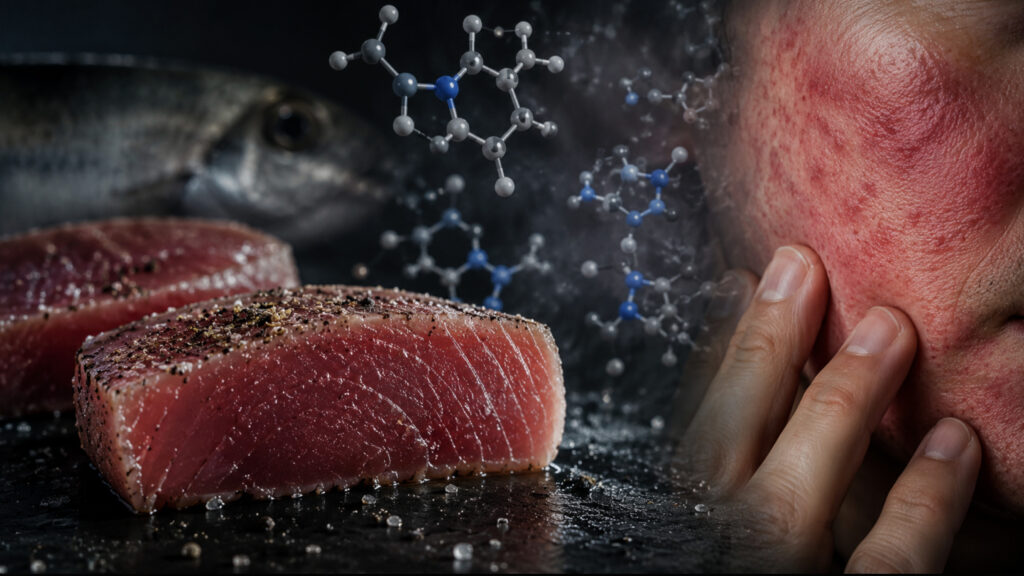
The tuna contained elevated histamine.
Not the histamine produced by one person’s immune system during an allergic reaction.
Histamine already present inside the fish.
The diners had effectively eaten a large dose of a chemical their bodies normally produce during allergic reactions.
No wonder it felt like an allergy.
The Condition Has a Strange Name
It’s called scombroid poisoning.
You’ll also see it called histamine fish poisoning or scombrotoxin fish poisoning.
The name comes from the historical association with fish in the Scombridae family, including tuna and mackerel.
But the name is misleading.
Other fish can cause it too.
Mahi-mahi.
Sardines.
Anchovies.
Herring.
Amberjack.
Bluefish.
And several others.
The real requirement isn’t the family name.
It’s chemistry.
The Fish Starts With Something Completely Normal
Certain fish naturally contain high levels of an amino acid called histidine in their muscle.
Histidine isn’t the problem.
It’s a normal component of proteins.
The trouble begins after the fish dies.
If the fish isn’t chilled properly, certain bacteria can multiply.
Those bacteria possess enzymes capable of turning histidine into something else.
Histamine.
And Histamine Is Where the Nightmare Begins
Most people know histamine from allergies.
Pollen enters your nose.
Your immune system reacts.
Histamine contributes to itching, swelling, redness, runny nose and other familiar symptoms.
That’s why antihistamines exist.
Now imagine skipping the immune-system step.
Instead of your own cells releasing histamine, you swallow a large amount already sitting inside a piece of fish.
The body can respond in eerily similar ways.
Flushing.
Headache.
Itching.
Rash.
A racing heart.
Nausea.
Diarrhea.
Burning around the mouth.
Sometimes low blood pressure.
Sometimes breathing problems.
The meal can make a perfectly non-allergic person look as though they’re having an allergic reaction.
The Fish Doesn’t Have to Look Spoiled
This is the detail that makes scombroid poisoning so unnerving.
People rely on their senses.
If fish is dangerous, surely it will stink.
Surely the flesh will be slimy.
Surely the color will be obviously wrong.
Not necessarily.
The tuna investigated in the Pennsylvania outbreak had been described as having good physical appearance when delivered.
It looked like food.
That’s what everyone expected it to be.
Sometimes There Is a Taste
Scombroid-contaminated fish can occasionally have an unusual taste.
Peppery.
Sharp.
Metallic.
One older CDC outbreak investigation found diners describing implicated mahi-mahi as strangely “hot” or spicy.
But even that isn’t reliable enough to protect you.
Some contaminated fish may taste completely normal.
And seasoning can blur the clues even further.
A peppery piece of grilled tuna in a restaurant is hardly going to make everyone immediately think:
Histamine poisoning.
The Fish Isn’t Actually Producing Histamine by Itself
The transformation depends heavily on bacteria and temperature.
After a fish is caught, refrigeration becomes critical.
If certain histamine-forming fish spend too much time warm, bacteria get an opportunity to work.
Their enzymes convert naturally occurring histidine into histamine.
The longer favorable conditions persist, the more can accumulate.
And once enough has formed, you have a problem that refrigeration can no longer reverse.
Cold prevents the next stage.
It doesn’t erase the previous one.
So Put It in the Freezer?
Too late.
This is where scombroid poisoning breaks another familiar food-safety rule.
Freezing does not remove histamine once it has formed.
You can freeze contaminated fish solid.
Thaw it later.
The histamine remains.
Fine.
Then cook it.
There’s an even worse surprise waiting.
Cooking Doesn’t Destroy It Either
Grill the tuna.
Bake it.
Smoke it.
Can it.
Cook it until there isn’t a hint of raw flesh left.
Histamine is heat-stable enough to survive normal food preparation.
The bacteria may die.
The chemical they already produced remains.
The food can therefore be thoroughly cooked and still cause illness.
Think about how unsettling that is.
Heat is the thing we trust to make questionable food safer.
With this particular problem, heat arrives after the damage has already been done.
The Dangerous Moment May Have Happened Hours or Days Earlier
The person who cooks the fish may have done everything correctly.
The restaurant may refrigerate it properly.
The diner may eat it immediately.
And people can still become sick.
Because temperature abuse might have occurred before the restaurant ever received it.
On the fishing vessel.
At the dock.
During processing.
During transportation.
While thawing.
At some other point in a long supply chain.
The poison is created by a mistake in the fish’s history.
You eat the evidence later.
Investigators Tried to Follow That History
The Pennsylvania tuna didn’t simply appear in the restaurant refrigerator.
Investigators traced it backward.
It came from a yellowfin tuna caught commercially in the Gulf of Mexico.
The fish moved through a chain involving multiple processors and transporters before reaching the restaurant.
At several documented points, temperatures looked appropriately cold.
That made the investigation more frustrating.
Somewhere between ocean and plate, conditions had allowed enough histamine to form.
Pinpointing exactly when wasn’t simple.
The Tuna Had Traveled a Long Way
A single fish can change hands repeatedly.
Boat.
Dock.
Processor.
Truck.
Wholesaler.
Supplier.
Restaurant.
Kitchen.
Plate.
Every stage inherits the consequences of what happened before it.
A restaurant can make perfect grill marks.
It can’t grill history out of the meat.
That is why seafood refrigeration begins almost immediately after the fish is caught.
The clock matters.
In Another Outbreak, Eight People Became Sick
The Pennsylvania case wasn’t unique.
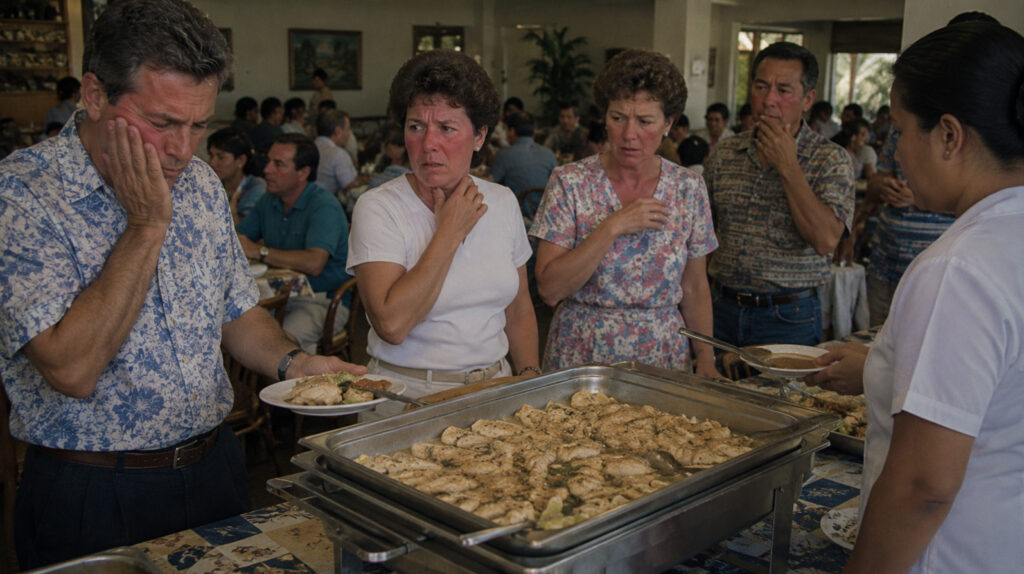
In 1988, eight people at a private club in Chicago developed scombroid poisoning after a buffet lunch.
Five were patrons.
Three were employees.
Most had eaten mahi-mahi with dill sauce.
One hadn’t even eaten the fish itself.
That person had eaten sauce scraped from the pan that held the fish.
That was enough.
The Sauce Was a Clue
If the toxin were confined neatly inside an untouched piece of fish, perhaps avoiding the flesh would have been enough.
But the serving juices and sauce had been in contact with it.
Histamine isn’t something you can necessarily remove by scraping off one suspicious section.
In the Chicago investigation, multiple people described the fish as unusually spicy or hot.
About 90 minutes later, symptoms including flushing, headache, nausea, dizziness and diarrhea appeared.
Dinner had become an outbreak.
There Were More Cases in South Carolina
That same year, health officials investigated another cluster in Charleston.
Yellowfin tuna was implicated.
The fish had been kept chilled at the restaurants before being broiled and served.
Again, cooking didn’t save anyone.
The critical mistake had probably occurred earlier.
The pattern kept repeating.
Normal-looking fish.
Proper cooking.
Sudden allergy-like illness.
Then the discovery of histamine.
Decades Later, It Still Happens
This isn’t merely an old food-safety problem that disappeared with better refrigerators.
A CDC analysis published in 2026 reviewed marine-toxin outbreaks reported in the United States from 2009 through 2020.
Scombroid toxin accounted for 192 reported outbreaks and 597 illnesses in that dataset.
Most of the outbreaks with an identified food source involved tuna.
More than half of the outbreaks with a known single preparation location were associated with sit-down restaurants.
The problem survives because all it takes is one break in temperature control somewhere along the chain.
Tuna Is Particularly Good at Hiding the Problem
Tuna is eaten in countless forms.
Steaks.
Salads.
Sushi.
Poke.
Sandwiches.
Canned products.
A tuna steak can arrive beautifully red and be cooked perfectly.
That visual quality tells you surprisingly little about whether histamine accumulated earlier.
You cannot see histamine.
You cannot reliably smell it.
And kitchen heat doesn’t make it vanish.
The important work happened before cooking ever began.
Then Why Doesn’t Everyone Get Sick?
Histamine isn’t necessarily distributed evenly throughout an entire fish or batch.
One portion may contain more than another.
People also eat different quantities.
Individual sensitivity can vary.
That can create confusing outbreaks.
One person becomes intensely ill.
Someone beside them experiences only mild flushing.
Another person notices almost nothing.
The uneven pattern can initially make a shared food seem less suspicious.
Until more people start reporting the same strange symptoms.
The Speed Is Another Clue
Many common foodborne infections take considerably longer to cause illness.
Bacteria must survive digestion.
Sometimes multiply.
Sometimes produce toxins.
Symptoms may appear many hours or even days later.
Scombroid poisoning can move much faster.
Symptoms commonly begin within minutes to an hour or two after eating.
One minute you’re finishing tuna.
Not long afterward, your face feels hot.
Your heart starts pounding.
Your mouth burns.
That short interval is one reason the condition is so often mistaken for allergy.
You May Think You’re Having Anaphylaxis
And in severe cases, that possibility has to be taken seriously.
Some scombroid reactions can include wheezing, swelling, low blood pressure or other symptoms that overlap with dangerous allergic reactions.
A person at home cannot always reliably distinguish one from the other.
That isn’t the time for an internet diagnosis.
Severe breathing difficulty, fainting, significant swelling or cardiovascular symptoms require urgent medical attention regardless of the cause.
Doctors can sort out the mystery after the immediate danger is addressed.
But There’s One Question That Can Change Everything
“Did anyone else eat the fish?”
Imagine two friends arriving at an emergency department.
Both have red faces.
Both complain of pounding headaches.
Both feel their hearts racing.
Both ate the same tuna less than an hour earlier.
Neither has a history of fish allergy.
Now the picture looks different.
Two people can share contaminated food.
They don’t suddenly develop the same new immune-system allergy at exactly the same meal.
Antihistamines Can Work Quickly
Because histamine is central to the syndrome, antihistamine medications are often used for treatment.
Many patients improve rapidly.
Most cases are self-limited and resolve within hours, although symptoms can occasionally persist longer.
Severe cases are much less common.
That sounds almost anticlimactic compared with the sudden onset.
But that’s part of what makes the illness strange.
A person can go from a normal dinner to feeling dramatically ill and back toward normal within the same day.
The fish has already delivered its dose.
The body has to clear it.
The Name Causes Confusion
“Scombroid” sounds like a bacteria.
It isn’t.
It sounds like a parasite.
It isn’t that either.
It’s a poisoning syndrome named after fish historically associated with it.
No infectious organism needs to establish itself inside you.
The bacteria did their important work before you ate the meal.
They transformed histidine in the fish.
You swallowed what was left behind.
It’s closer to chemical intoxication than an infection.
The Fish Can Be Dead While the Chemistry Keeps Changing
That’s another uncomfortable thought.
We tend to imagine spoilage as decomposition we can observe.
The smell becomes worse.
The texture breaks down.
Color changes.
But chemistry can change before the food reaches that dramatic stage.
Histamine-forming bacteria don’t need the fish to look horrifying before they matter.
Time plus warmth can be enough.
The danger begins while the fish still looks like dinner.
This Is Why the Cold Chain Matters So Much
Seafood professionals talk about the “cold chain.”
It’s exactly what it sounds like.
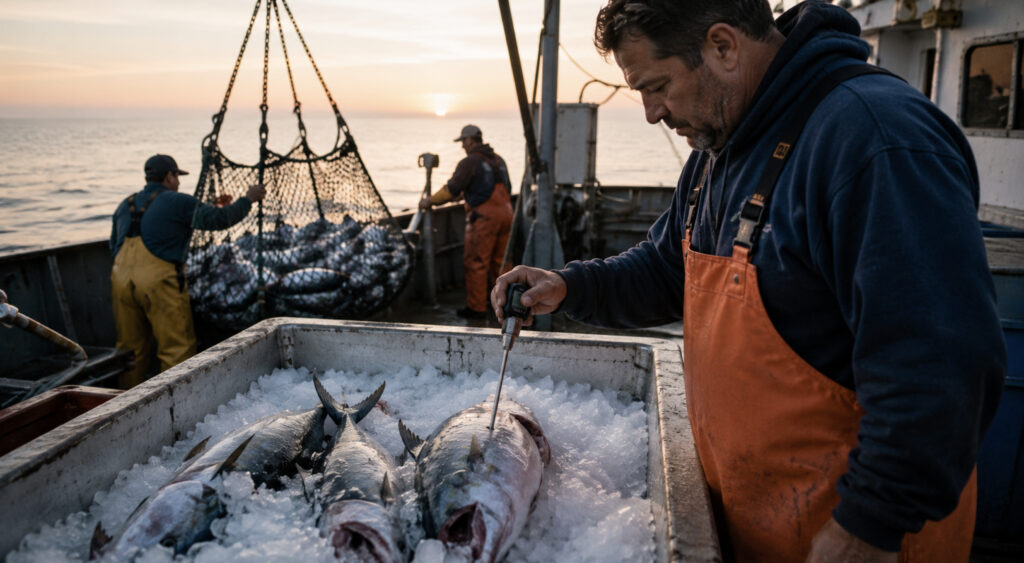
From the moment a vulnerable fish is caught, it needs to stay cold through handling, processing, transport and storage.
Break the chain and bacterial activity can increase.
Restore refrigeration later and bacterial growth may slow again.
But any histamine already formed doesn’t politely disappear.
The mistake becomes permanent.
The thermometer can return to normal.
The fish cannot return to the state it was in before.
You Can’t Fix It at Home
There’s no trick.
No lemon juice.
No soaking.
No extra-hot grill.
No rinse under the tap.
No freezing overnight.
No removing the skin.
Once high levels of histamine exist in the flesh, normal kitchen methods can’t reliably make the fish safe again.
Prevention has to happen earlier.
That’s why food regulators focus so heavily on time and temperature control rather than telling consumers how to “detox” suspicious fish.
There May Be One Warning at the Table
If fish tastes unusually peppery, metallic, burning or simply wrong, stop eating it.
That doesn’t mean every spicy-tasting tuna steak contains histamine.
Seasoning exists.
So do naturally strong flavors.
But an unexplained sharp or peppery sensation—especially if diners begin flushing or developing headaches shortly afterward—deserves attention.
Don’t keep eating because the fish was expensive.
Don’t assume the grill will have sterilized every possible problem.
And don’t let a beautiful plate overrule what your mouth is telling you.
The Restaurant Didn’t Cause an Allergy
That’s the final twist in cases like Pennsylvania.
The patients looked allergic.
The symptoms behaved like allergy.
Antihistamines helped.
Yet the diners’ immune systems weren’t independently deciding tuna was suddenly an enemy.
The reaction had effectively arrived preloaded in the food.
Histamine had accumulated inside the fish before anyone ordered lunch.
The diners merely swallowed it.
Which Makes the First Bite Much More Disturbing
We like food dangers with obvious villains.
Raw chicken.
Bulging cans.
Mold.
Rotten smells.
Things we can recognize and avoid.
Scombroid poisoning isn’t courteous enough to look dangerous.
The tuna may be perfectly seared.
The center may be beautifully pink.
The plate may come from an excellent restaurant.
The first warning might not arrive until the fish is already in your mouth.
A metallic taste.
A strange burn.
Then heat spreading across your face.
Someone at the table asks why you’re suddenly red.
Another person says their head hurts.
A third reaches for water.
And that’s when everyone begins looking back at the same plate.
[IMAGE SUGGESTION: Absolute photorealistic final editorial image, elegant restaurant table with half-eaten seared tuna in foreground, three diners in background exchanging alarmed looks as one face appears flushed and another person grips a glass of water, meal still visually appetizing, cinematic low restaurant lighting, realistic expressions, quiet dread rather than exaggerated horror, no text, 16:9.]
The Fish Wasn’t Dangerous When It Was Alive
That’s the part worth remembering.
The tuna didn’t swim through the ocean filled with enough histamine to poison diners.
The conditions came later.
After it was caught.
After normal biology met bacteria.
After time and temperature allowed one harmless amino acid to become something else.
By the time the fish reached the plate, the mistake may have happened days earlier and hundreds of miles away.
Nobody at the table could see it.
Nobody could cook it away.
The meal simply carried the history with it.
Then, within minutes, their bodies revealed what the fish had been hiding.

