
Archaeologists Opened a Sealed Tomb—Then They Realized the Body Inside Didn’t Belong There
The entrance had been blocked for thousands of years.
Twenty-one stone steps disappeared into the floor of Egypt’s Valley of the Kings, ending at a doorway packed shut with limestone.
The seals were still there.
A jackal crouched above nine bound enemies—the unmistakable mark of the royal necropolis.
Whatever waited beyond that doorway had been deliberately shut away.
So in January 1907, archaeologist Edward Ayrton began opening it.
At first, the tomb looked disappointingly small.
Then he reached the burial chamber.
A gilded coffin waited inside.
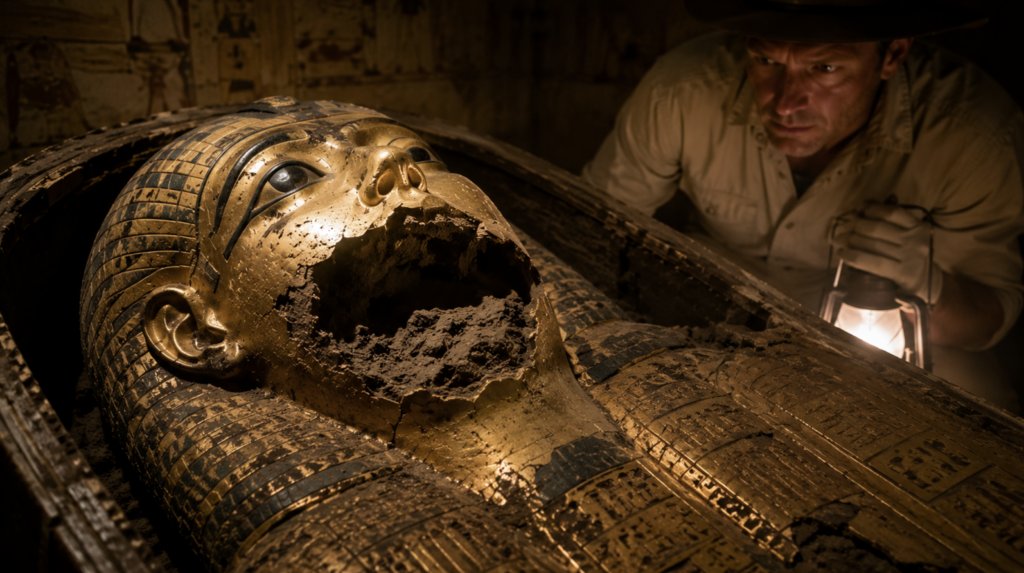
Its face had been violently hacked away.
The name of the person inside had been erased.
And when researchers examined the body, they discovered something even stranger.
The coffin had originally been made for a woman.
The skeleton inside belonged to a man.
Someone had changed the burial.
Someone had removed the dead person’s identity.
And whoever had been placed inside was apparently never supposed to be there in the first place.
The Tomb Didn’t Have a Name
Egyptologists identify tombs in the Valley of the Kings with numbers.
This one became KV55.
There were no beautiful wall paintings announcing the owner.
No carved scenes of a pharaoh entering the afterlife.
No long inscriptions covering the chambers.
KV55 was almost brutally plain.
A staircase.
A corridor.
A burial chamber.
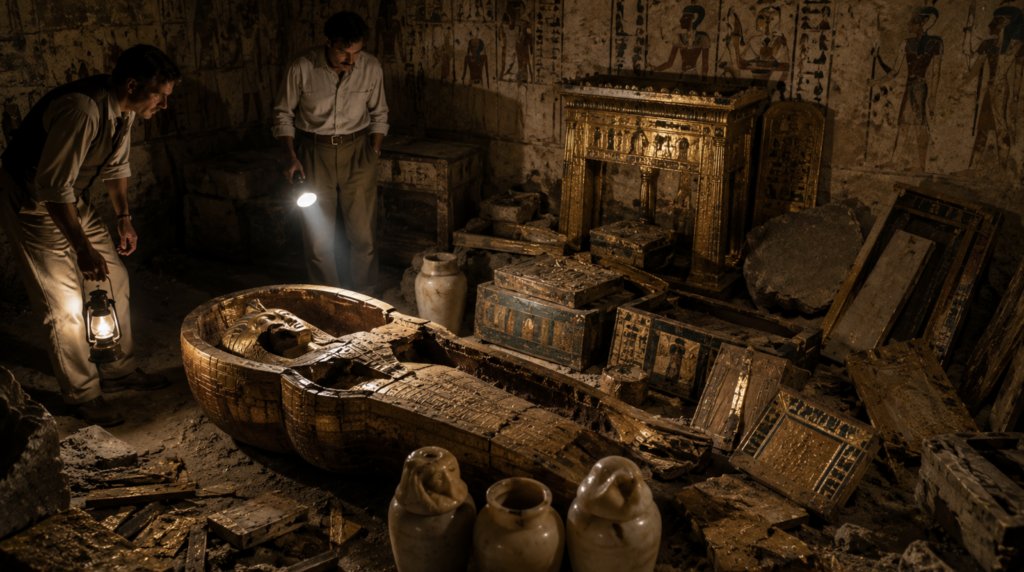
And inside, one of the strangest collections of royal objects ever found in Egypt.
Something Had Already Gone Wrong
The coffin should have solved the mystery immediately.
Royal Egyptian coffins often carried names and titles precisely because identity mattered enormously in the afterlife.
But someone had attacked this one.
The golden mask covering much of its face had been ripped away.
The cartouches—the oval frames containing royal names—had been deliberately cut out.
This wasn’t ordinary decay.
Someone wanted the person inside to become anonymous.
And They Had Done a Thorough Job
The missing name wasn’t confined to one damaged section.
Where identifying cartouches had once appeared, there were empty scars.
Part of the face itself had been destroyed.
Even inscriptions elsewhere in the tomb had been altered.
The ancient Egyptians placed extraordinary importance on preserving a person’s name.
Destroying it could carry a terrifying meaning.
To erase someone’s name was not simply vandalism.
It could be an attempt to erase their existence.
Then the Objects Started Naming Other People
The coffin had lost its identity.
The objects around it had not.
A large gilded shrine carried the name of Queen Tiye, one of the most powerful women of Egypt’s 18th Dynasty.
Other objects referred to her husband, Pharaoh Amenhotep III.
There were items linked to Princess Sitamun.
Then came another name.
Tutankhamun.
The boy king whose tomb wouldn’t be discovered until fifteen years later.
KV55 seemed less like one person’s burial and more like somebody had emptied part of an entire royal family’s history into a single chamber.
Then They Found Akhenaten
Among the objects were four magical bricks.
They carried the name of Akhenaten.
That name changed everything.
Akhenaten was not an ordinary pharaoh.
More than 3,000 years earlier, he had thrown Egypt’s religious world into turmoil.
He elevated the Aten—the solar disk—above Egypt’s traditional gods and built a new capital far from Thebes.
He even changed his own name.
After his death, much of what he created was dismantled.
His images were attacked.
His name was removed.
Later kings tried to write him out of Egyptian history.
And now, inside KV55, someone had done exactly the same thing to the coffin.
Was the Nameless Body Akhenaten?
The possibility was almost irresistible.
A mutilated royal coffin.
A name deliberately removed.
Objects belonging to Akhenaten’s family.
Magical bricks carrying Akhenaten’s own name.
Maybe archaeologists had found the missing heretic king.
There was just one enormous problem.
The body didn’t seem old enough.
At First, They Thought It Was a Woman
The skeleton inside the coffin was badly damaged.
Little remained of the original mummy except bones and deteriorated material.
Early observers believed the remains might be female.
That fitted neatly with the objects belonging to Queen Tiye.
The excavation was even published as the discovery of the tomb of Queen Tiye.
For a brief moment, the puzzle appeared solved.
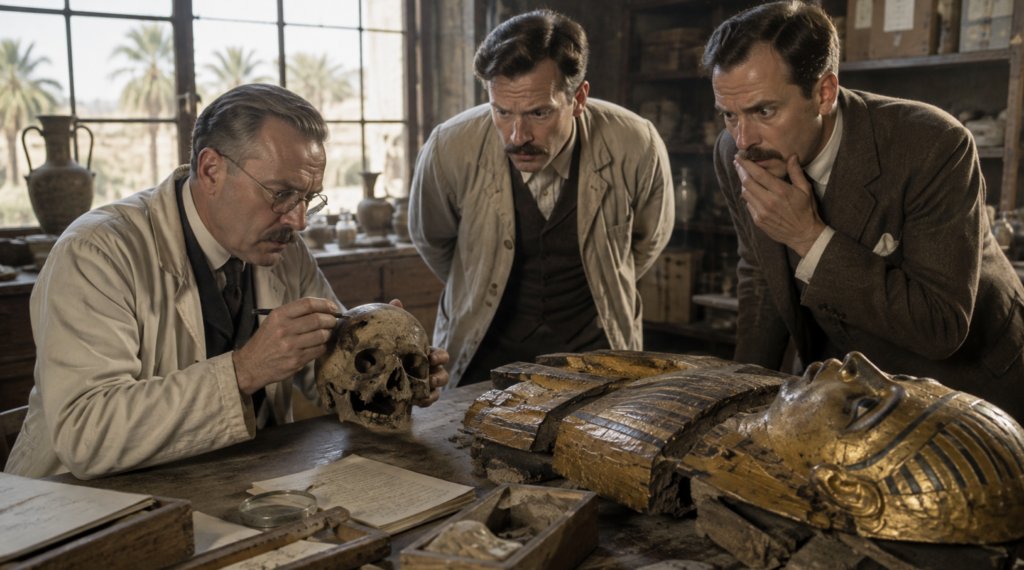
Then anatomist Grafton Elliot Smith examined the remains.
And the entire story collapsed.
The Skeleton Was Male
Smith concluded the bones belonged to a man.
Suddenly, Queen Tiye could no longer be the straightforward answer.
The beautiful coffin created another contradiction.
Closer study showed that it too had originally been designed for a woman.
Feminine grammatical endings remained hidden in portions of the altered hieroglyphic text.
Even a female pronoun survived.
Someone had taken a royal woman’s coffin and rewritten it for a man.
The conversion wasn’t perfect.
Ancient editors had left evidence behind.
The Coffin May Have Belonged to Someone Else Entirely
Modern study has made the coffin’s history even stranger.
Many Egyptologists believe it was originally made for Kiya, a secondary wife of Akhenaten.
Kiya was once important enough to possess elaborate royal funerary equipment.
Then she disappeared from the historical record.
Her monuments were taken over.
Her titles were altered.
And apparently, parts of her burial equipment were reused.
The coffin in KV55 may have been one of them.
Someone removed the woman’s identity.
Then adapted the coffin for a royal man.
Then someone else later destroyed the man’s identity too.
One coffin.
At least two owners.
Neither name surviving intact.
There Were Other Things Belonging to Kiya
A set of beautiful calcite canopic jars was also found inside KV55.
They had originally been prepared for Kiya.
These vessels were designed to hold organs removed during mummification.
That made the tomb even harder to understand.
Queen Tiye’s shrine was there.
Kiya’s funerary equipment was there.
Akhenaten’s magical bricks were there.
Tutankhamun’s seal appeared at the entrance.
But only one body remained.
KV55 was becoming less like a tomb.
It was starting to look like a royal evacuation.
Something Had Happened at Amarna
Akhenaten had built his new capital at a place now called Amarna.
He also prepared a royal tomb there.
There is strong evidence that Akhenaten was originally buried in that tomb after his death.
But the city did not survive him for long.
Egypt’s rulers abandoned Amarna.
Traditional religious institutions returned.
The Aten revolution was dismantled.
And the royal dead suddenly had a problem.
Their burial place was sitting inside a city Egypt wanted to forget.
Someone Went Back for the Bodies
Seal impressions found at KV55 include the name of Tutankhamun.
That places an important part of the story around his reign.
One possibility is that members of the Amarna royal family were removed from their original tombs and transported south to the traditional royal cemetery at Thebes.
Imagine the operation.
Ancient workers entering abandoned royal tombs.
Opening burial chambers.
Moving mummies that had already been laid to rest.
Gathering coffins, shrines, jars and magical objects.
Then transporting them hundreds of kilometers back toward the Valley of the Kings.
Not as treasure.
As damaged remnants of a royal family whose revolution had failed.
KV55 May Have Been a Storage Room for the Dead
That would explain the chaos.
The tomb doesn’t look as though one ruler commissioned a perfect burial and carefully filled it with matching possessions.
It looks reused.
Improvised.
Objects belonging to different people were brought together.
A woman’s coffin was altered for a man.
A queen’s shrine was dismantled and placed inside.
Funerary equipment was repurposed.
Someone was solving a problem quickly.
The dead needed somewhere to go.
KV55 may have been the answer.
But Why Erase the Man’s Name?
Moving a body is understandable.
Destroying its identity is something else.
Akhenaten had become politically and religiously toxic.
Later generations attacked his monuments.
His Aten temples were dismantled.
Stone blocks carrying his images were reused inside other buildings.
His name vanished from king lists.
Egypt tried to repair the world he had changed.
If the body in KV55 belonged to Akhenaten, the hacked coffin suddenly makes terrible sense.
Someone didn’t simply move the dead king.
Someone wanted him forgotten.
Except the Bones Kept Saying “Too Young”
For much of the 20th century, anatomical examinations estimated that the KV55 man died somewhere in his twenties.
Akhenaten had ruled Egypt for roughly seventeen years.
He was already old enough to have children early in his reign.
That made a death in the early twenties extremely difficult to reconcile with the historical king.
Another candidate emerged.
Smenkhkare.
The Other King Almost Nobody Understands
Smenkhkare is one of ancient Egypt’s most mysterious rulers.
He appears briefly near the end of the Amarna Period.
His exact relationship to Akhenaten remains debated.
He may have ruled alongside him.
He may have succeeded him.
Even his place inside the royal family is uncertain.
Most importantly for KV55, Smenkhkare could plausibly have died young.
If the skeleton really belonged to a man in his early twenties, the mystery seemed almost solved again.
Akhenaten’s objects might simply have been stored alongside someone else’s body.
Then Tutankhamun’s Tomb Changed the Mystery
In 1922, Howard Carter discovered KV62.
Tutankhamun.
The boy king had been buried astonishingly close to KV55.
Scientists eventually noticed physical similarities between Tutankhamun’s remains and the unidentified KV55 man.
Blood-group testing later suggested a close biological relationship.
The nameless skeleton was not just somebody from the right historical period.
He appeared to belong to Tutankhamun’s family.
The question became more precise.
Was this Tutankhamun’s father?
Then DNA Entered the Tomb
More than a century after KV55 was opened, researchers tested royal mummies from Tutankhamun’s family.
The results published in 2010 were extraordinary.
The KV55 man was genetically identified as a son of the mummy associated with Amenhotep III and Queen Tiye’s line.
More importantly, the researchers concluded that KV55 and another unidentified royal mummy were the biological parents of Tutankhamun.
The faceless man inside KV55 was almost certainly extremely close to the center of the Amarna royal family.
The genetic evidence pointed strongly toward Akhenaten.
The Bones Suddenly Got Older
CT examination used in the same research estimated the KV55 individual had died between approximately 35 and 45 years old.
That range fits Akhenaten far better.
The investigators identified the mummy as Akhenaten.
For newspapers, documentaries and television programs, the mystery finally had an ending.
The missing heretic pharaoh had been found.
Except Egyptologists kept arguing.
The Mystery Refused to Die
Not everyone accepts the age estimate.
Other specialists have continued to argue that features of the skeleton suggest a significantly younger man.
Ancient DNA work on Egyptian mummies has also been debated because contamination, degradation and family relationships can complicate interpretation.
So two identities remain attached to KV55.
Akhenaten.
Smenkhkare.
One fits much of the archaeological and genetic evidence.
The other fits some interpretations of the skeleton’s age.
The man had lost his name more than 3,000 years ago.
Modern science still hasn’t given it back with absolute certainty.
But One Thing Is Certain
The coffin did not begin with him.
It was made for a royal woman.
Then it was modified.
The inscriptions were rewritten.
Male royal symbols were added.
The body of a man was placed inside.
Later, his face and name were attacked.
Whatever happened in KV55 wasn’t a normal royal burial.
It was a burial assembled from someone else’s afterlife.
That’s What Makes the Coffin So Unsettling
Ancient Egyptian royal funerals were supposed to defeat chaos.
Everything mattered.
The correct coffin.
The correct name.
The correct magical texts.
The correct objects.
The correct tomb.
KV55 contains the opposite.
People are mixed together.
Objects are reused.
Names are removed.
Identities overlap.
A woman’s coffin holds a man.
A queen’s shrine sits beside another woman’s jars.
A disgraced king’s name survives on magical bricks while someone carefully destroys the name on the coffin beside them.
It feels less like a funeral.
It feels like evidence left after something went wrong.
The Ancient Destruction May Have Been Deliberate
If the body was Akhenaten, whoever attacked the coffin may have been participating in the campaign against his memory.
The Egyptians had a concept modern historians sometimes describe as a form of damnation through erasure.
The dead needed their identity.
Their names kept them present.
Images allowed them to continue existing.
Destroy the face.
Destroy the name.
And you attacked something deeper than a monument.
You attacked eternity.
Akhenaten had attempted to transform Egyptian religion.
His enemies may have tried to make sure he paid for it forever.
Yet Someone Had Also Tried to Save Him
That’s the contradiction.
If the KV55 man is Akhenaten, someone first took the trouble to recover his body from Amarna.
They transported him back toward Egypt’s traditional royal necropolis.
They found a coffin.
They altered it.
They placed royal funerary objects around him.
Someone believed he deserved protection.
Then, at another point, somebody apparently believed he deserved destruction.
The same body became both rescued ancestor and hated enemy.
Tutankhamun May Have Been Caught in the Middle
Tutankhamun came to the throne as a child.
He was born Tutankhaten, his original name honoring the Aten.
Then his name changed.
Tutankhaten became Tutankhamun.
The court returned to the traditional gods.
Amarna was abandoned.
And seal impressions bearing Tutankhamun’s name appeared at KV55.
If the mummy is Akhenaten, the implications are extraordinary.
The young king’s government may have helped move his father’s body while simultaneously reversing almost everything his father had stood for.
Family loyalty and political survival could have occupied the same tomb.
Then the Door Closed
At some point, the limestone blocking went back into place.
The necropolis seal was stamped onto it.
The corridor went dark.
The coffin deteriorated.
Floodwater entered over the centuries.
Wood collapsed.
Gold loosened.
The body decayed until almost nothing remained but bone.
And the man without a name waited.
Three Thousand Years Later, They Opened the Wrong Coffin
Not wrong because archaeologists made a mistake.
Wrong because the coffin itself was wrong.
It belonged to someone else.
Its inscriptions had been rewritten.
Its face had been destroyed.
Its owner’s name had been hacked out.
Yet the body inside carried a genetic connection to one of the most famous pharaohs in history.
The ancient attempt to erase him had failed in a way nobody could have imagined.
They removed the name.
Science began reconstructing the family.
And We Still Can’t Say His Name With Complete Confidence
Akhenaten remains the leading identification for many researchers.
Others continue to argue for Smenkhkare.
That uncertainty is almost appropriate.
Whoever attacked the coffin wanted the man inside to become anonymous.
They succeeded for more than thirty centuries.
Edward Ayrton opened the tomb in 1907.
Researchers examined the bones.
Studied the coffin.
Translated altered inscriptions.
Compared skulls.
Tested blood.
Scanned the skeleton.
Extracted DNA.
More than a century of investigation has narrowed the possibilities dramatically.
But the final answer still refuses to stay completely still.
The nameless man of KV55 is probably one of two kings.
And somewhere in the missing gold, beneath the scars where a cartouche once existed, was the one piece of evidence that could have ended the mystery immediately.
Someone removed it thousands of years before archaeologists arrived.
They didn’t just bury a body.
They buried the answer.
[IMAGE SUGGESTION: Absolute photorealistic final editorial image, damaged ancient Egyptian gilded royal coffin emerging from darkness in a Valley of the Kings tomb, erased golden face and empty hacked cartouche sharply visible in foreground, faint human skeleton inside, modern archaeologist in background staring in disbelief under flashlight beam, dramatic but realistic shadows, historical mystery mood, no supernatural elements, no text, 16:9.]